 Why Did the Ming Emperors Choose This Location for Their Tombs?
 Why Did the Ming Emperors Choose This Location for Their Tombs?
One of the most common questions foreign visitors ask is: why were the Ming Tombs built in this specific place near Beijing?
The answer lies in history, politics, and traditional Chinese feng shui.
When the Ming Dynasty was founded, the capital was not Beijing. The first emperor, Zhu Yuanzhang, ruled from Nanjing, where he built both his imperial palace and his mausoleum. After his death, the throne passed to his grandson, Zhu Yunwen, because Zhu Yuanzhang’s eldest son had already died.
However, this peaceful succession did not last long.
From Nanjing to Beijing: A Change of Power and Capital
Zhu Yuanzhang’s fourth son, known as the Prince of Yan, launched a civil war against his nephew. This conflict, later called the Jingnan Campaign, ended with the prince seizing the throne. He became the Yongle Emperor, known in history as Zhu Di.
After taking power, Zhu Di made a decisive move: he relocated the capital from Nanjing to Beijing. At the same time as building the Forbidden City, he also began planning a new imperial burial ground. This decision marked the beginning of what we now call the Ming Tombs.
Searching for the Perfect Feng Shui Site
In 1407, tragedy struck again when Empress Xu, Zhu Di’s wife, passed away. Instead of burying her in Nanjing, Zhu Di ordered a search for an auspicious site near the new capital.
He sent senior officials from the Ministry of Rites and invited Liao Junqing, a renowned feng shui master from a famous geomancy family in Jiangxi. The Liao family had been respected for centuries for their expertise in site selection and land geomancy.
Over nearly two years of field investigation, several possible locations were carefully examined.
Rejected Sites and Cultural Taboos
Some candidate locations were rejected for reasons that may seem unusual today but were taken very seriously at the time.
Tujia Camp, north of the Great Wall, was dismissed because the surname “Zhu” sounds similar to the word “pig” in Chinese, and the name carried negative symbolism.
Yang Mountain, southwest of Changping, was abandoned due to a nearby village named “Wolf Mouth Valley,” considered inauspicious for the imperial family.
Yanjia Terrace in western Beijing was rejected because its pronunciation resembled a phrase meaning “the emperor’s death.”
Tanzhe Temple, although beautiful, was located deep in the mountains and lacked sufficient space for future generations.
Each site failed either symbolically or practically.
The Final Choice: Tianshou Mountain
In 1409, Zhu Di personally inspected Huangtu Mountain, later renamed Tianshou Mountain. He was immediately impressed by its natural layout.
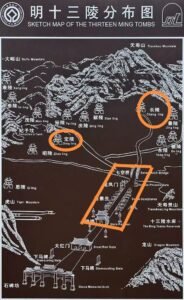
From a feng shui perspective, the site was ideal. Mountains surround it on three sides, forming a protective embrace. To the south, two hills stand opposite each other like natural gatekeepers. The Wenyu River flows gently through the open valley, creating a classic “backed by mountains, facing water” formation.
Many people describe the terrain as resembling a giant armchair: strong support behind, balanced protection on both sides, and open space in front. In Chinese feng shui, this symbolizes stability, protection, and lasting prosperity. Even today, many Chinese still believe this layout represents excellent feng shui.
Zhu Di declared the area a “land of eternal fortune”, renamed it Tianshou Mountain, and began construction the same year. This decision established the foundation for all later Ming imperial tombs.
Why This Feng Shui Still Matters Today
The Ming Tombs feng shui was not only about superstition. It reflected imperial power, long-term planning, and harmony between humans and nature. The chosen location allowed future emperors to build their tombs following a unified pattern, creating one of the most complete imperial burial landscapes in China.
That is why, more than six centuries later, the Ming Tombs still attract visitors curious about both Chinese history and feng shui philosophy.