Ming Dynasty Tombs (Thirteen Tombs): History, Layout, Symbols, and Visitor Guide
 Ming Dynasty Tombs Visitor Guide
 Ming Dynasty Tombs Visitor Guide
The Ming Dynasty Tombs, also known as the Thirteen Tombs of the Ming Dynasty, are located about 45 kilometers northwest of central Beijing. This vast imperial burial complex served as the final resting place for 13 emperors of the Ming Dynasty (1368–1644) and represents one of the most complete and well-preserved royal tomb systems in China.
Covering an area of more than 40 square kilometers, the tombs are set within a natural valley carefully chosen for its geographical and symbolic significance. Beyond being a burial ground, the Ming Tombs reflect ancient Chinese beliefs about power, the afterlife, and harmony between humans and nature.
During visits with international travelers, questions often go beyond dates and names—many visitors want to understand why the tombs were built here, how the layout works, and what the stone structures along the way truly represent. This guide brings those elements together in one place.
Why the Ming Tombs Were Built Here: Feng Shui and Imperial Planning
The site of the Ming Tombs was selected during the reign of the Yongle Emperor in the early 15th century. According to traditional Chinese Feng Shui principles, an ideal burial site should be backed by mountains, face open land, and be nourished by flowing water.
The Ming Tombs valley meets these criteria perfectly:
Mountains surround the site on three sides, forming a natural protective barrier
The open southern entrance allows energy to flow inward
A river once passed through the valley, symbolizing vitality and continuity
This “armchair-shaped” landscape—supported from behind and embraced on both sides—was believed to help preserve imperial authority even after death. For centuries, such layouts have been regarded in China as auspicious locations not only for tombs, but also for important settlements.
The Sacred Way (Spirit Way): A Symbolic Journey to the Afterlife
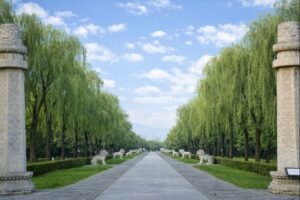
Before reaching the tombs themselves, visitors pass through the Sacred Way, also known as the Spirit Way. This ceremonial path served as the spiritual gateway between the earthly world and the imperial afterlife.
Along the route stand stone statues arranged in a precise order:
Mythical animals symbolizing protection
Real animals representing strength and loyalty
Civil and military officials guarding the emperor’s spirit
Among the most striking features are the granite pillars (Huabiao) and the Sacred Stele Pavilion. These structures were not decorative alone—they conveyed authority, cosmic order, and the emperor’s eternal mandate.
Each element along the Sacred Way follows a symbolic logic rooted in Confucian hierarchy and ancient ritual traditions.
Marble Pillars, Sacred Stele, and Stone Architecture
The stone structures at the Ming Tombs were carved from massive blocks of marble or bluestone transported from distant quarries—an extraordinary logistical achievement for the time.
Marble Pillars (Huabiao): Often misunderstood as purely ornamental, these pillars symbolized imperial communication with heaven and were traditionally placed at important ceremonial sites.
Sacred Stele: The stele pavilion records imperial achievements and legitimizes the ruler’s reign for future generations.
These elements helped transform the burial complex into a sacred political statement, reinforcing the emperor’s authority even in death.
(You may explore these features further through dedicated articles linked from this guide.)
Main Tombs Open to Visitors
While thirteen emperors are buried in the valley, only a few tombs are accessible to the public today.
Changling Tomb – Yongle Emperor
Changling is the earliest and grandest tomb in the complex. Its above-ground structures remain exceptionally well preserved.
The Hall of Eminent Favor is the largest surviving Nanmu wood structure in China
Massive wooden pillars were carved from single tree trunks over 600 years ago
Ancient Chinese emperors believed that life continued after death. These halls were not only ceremonial spaces but symbolic “offices,” where the emperor could continue ruling in the afterlife.
Visiting time: about 1 hour
Dingling Tomb – The Underground Palace
Dingling is the only Ming tomb whose underground chambers are open to visitors.
Excavated in 1957
Visitors descend approximately 27 meters underground
Stone chambers once housed the emperor and empresses, along with burial objects
The underground palace was designed like a fortress, meant to protect the emperor eternally.
Visiting time: about 1 hour (excluding transfers)
Visiting the Ming Tombs: Practical Tips for Foreign Travelers
The Ming Tombs are spread out; walking between sites can take too much time
Not all tombs are equally interesting for first-time visitors
Most travelers combine Changling or Dingling with the Sacred Way
Many visitors choose to pair the Ming Tombs with the Mutianyu Great Wall on the same day. However, travel time, seasonal crowds, and walking time on the great wall should be considered carefully—especially during public holidays.
Frequently Asked Questions
Are all Ming Tombs the same?
No. Each tomb reflects the emperor’s status, reign length, and historical circumstances.
Can all thirteen tombs be visited?
Most tombs remain sealed for preservation purposes.
Is the visit physically demanding?
The terrain is generally gentle, but distances between sites can be longer than expected.
Is a guided visit necessary?
Understanding the symbolism and layout greatly enhances the experience, especially for first-time visitors.
Explore More by Following the Ming Dynasty Tombs Visitor Guide
Planning Your Visit
The Ming Tombs are often explored as part of a private day trip from Beijing, mostly combined with the Great Wall Mutianyu section or Juyonguan section, depending on timing and visitor preferences.