 Did the Mongols Cross the Great Wall?
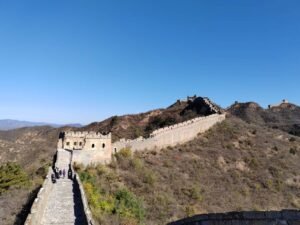 Did the Mongols Cross the Great Wall?
Did the Great Wall Actually Work?
For centuries, China’s central plains were dominated by agricultural societies, while the vast northern grasslands were home to nomadic peoples such as the Xiongnu, Khitan, Jurchen, and later the Mongols. These steppe groups relied on mobility and cavalry, and conflicts between the farming south and the nomadic north were a constant feature of Chinese history.
Sometimes, these encounters were small-scale raids—quick attacks to seize livestock or supplies. At other times, they took the form of full military invasions led by mounted armies. To defend themselves, the people of northern China began building walls, fortifications, and watchtowers long before China was unified.
The Origins of the Great Wall
In 221 BC, Qin Shi Huang, the First Emperor of China, unified the country. One of his major military projects was to connect many of these earlier regional walls into a single defensive system stretching across northern China. This early version of the Great Wall extended for thousands of kilometers.
Later dynasties, especially the Han and the Ming, continued to expand, repair, and reinforce these defenses. Over time, this evolving system formed the rough outline of what we now call the Great Wall of China.
For more than a thousand years, the wall served one main purpose: to control and deter invasions from the northern nomadic tribes. But the question remains—did it actually work?
Did the Great Wall Stop the Mongols?
The honest answer is: sometimes yes, sometimes no.
The Great Wall was never an impenetrable barrier. It was not designed to stop every invasion by itself. Instead, it functioned as a defensive system—a combination of walls, gates, signal towers, garrisons, and, most importantly, soldiers.
There is a famous saying attributed to Genghis Khan:
“I do not care how high or strong the wall is. I care about who is guarding it.”
This idea captures the reality of the Great Wall perfectly.
When the wall was well maintained, properly manned, and supported by a strong central government, it could be highly effective. Watchtowers allowed for early warning signals, gates controlled movement and trade, and garrisons slowed or redirected enemy forces.
However, when dynasties weakened—due to corruption, internal rebellion, or lack of resources—the wall became vulnerable.
How Did Invaders Get Past the Great Wall?
In most cases, invaders did not simply smash through the wall.
They crossed the Great Wall by:
Exploiting poorly defended gates
Taking advantage of internal betrayal or bribery
Entering during periods of political chaos
Marching through sections that were lightly guarded or neglected
The Mongols are a clear example. Genghis Khan and his successors did cross the Great Wall and eventually established control over northern China. Beijing later became the capital under the Yuan Dynasty.
Earlier dynasties founded by northern peoples, such as the Liao and Jin, also moved south of the Great Wall and ruled parts of China, often using Beijing as a secondary capital.
China’s last imperial dynasty, the Qing, was likewise established by a people from beyond the Great Wall.
So, Was the Great Wall a Failure?
Not at all.
Over the course of many centuries, the number of invasions that failed far exceeded those that succeeded. The Great Wall delayed attacks, reduced their scale, and bought time for defense. It also served as a powerful psychological and political symbol of imperial authority.
Rather than a single wall, it should be understood as a long-term military strategy—one that depended on leadership, logistics, and human judgment as much as stone and earth.
In the end, the Great Wall did not fail because it was crossed.
It succeeded because it shaped the history of warfare, diplomacy, and survival along China’s northern frontier for over a millennium.