The Sacred Way of the Ming Tombs: Large Stone Animals and Figures You Should Not Miss
When driving from downtown Beijing to any of the Ming Dynasty Tombs, you will inevitably pass by the Sacred Way of the Ming Tombs. However, many visitors do not realize it at first. Hidden by tall trees on both sides, the road looks just like an ordinary countryside avenue when viewed from inside a car.
To truly experience the Sacred Way, you need to stop at either the southern or northern entrance, get out of the car, and walk the path on foot. Traditionally, visitors follow the ancient ceremonial order, walking from south to north. The walk usually takes about 40 minutes at a relaxed pace.
What Is the Sacred Way of the Ming Tombs?
The Sacred Way, also known as the Main Sacred Way, is the grand ceremonial approach to Changling Tomb, the largest and most important tomb of the Ming Tombs complex. It is also the largest and best-preserved Sacred Way among all thirteen tombs.
The entire Sacred Way stretches approximately 7.3 kilometers. Construction began in the early Zhengtong period of the Ming Dynasty and was completed in 1540 during the Jiajing reign. Today, it is part of a UNESCO World Heritage Site.
In reality, modern visitors do not walk the full 7.3 kilometers. Large sections are now hidden within local orchards and villages. Most tours focus on the large stone aninals and figures carving section, which is about 800 meters long and represents the most impressive part of the Sacred Way.
Large Stone Animals and Figures Carvings Along the Sacred Way
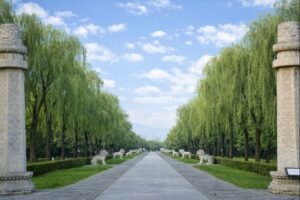 Along this section, visitors can see a remarkable lineup of 36 large stone sculptures, arranged symmetrically on both sides of the path. These carvings were created in pairs, forming 18 pairs in total.
Among them:
24 are large stone animals or mythical creatures
12 are large stone human figures, representing civil and military officials
Although some travelers refer to these as Ming tomb granite pillars, the carvings are actually made of traditional bluestone, a material commonly used in imperial architecture rather than granite or marble.
Large Stone Animals and Imperial Guardians
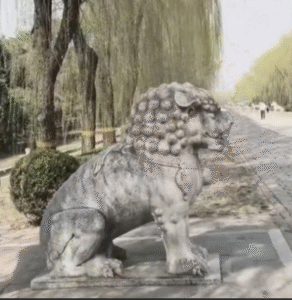
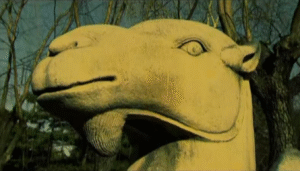 The stone animals, known collectively as Stone Statues of Beasts, include:
Lions
Xiezhi (mythical judicial beasts)
Camels
Elephants
Qilin
Horses
They are arranged in a precise ceremonial order, symbolizing imperial authority, protection, and the eternal guard of the emperors’ spirits.
Behind the animals stand the stone human figures, representing generals, civil officials, and meritorious ministers. Their calm expressions and dignified postures reflect the strict hierarchy and ritual system of the Ming court.
Walking the Sacred Way Today
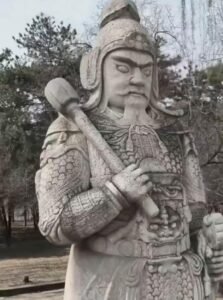 Walking among these sculptures is a quiet and immersive experience. Unlike crowded tomb chambers, the Sacred Way offers space, rhythm, and time to observe details up close. Many visitors find this walk to be one of the most memorable parts of visiting the Ming Tombs.
Visitor Information
Opening Hours
Peak season (April 1 – October 31): 8:10 – 17:50
Off season (November 1 – March 31): 8:30 – 17:00
Ticket Price
Peak season: 35 RMB
Off season: 25 RMB